SATPIN Learn the first six phonics sounds
Learn the sounds represented by s, a, t, p, i and n, then blend them to read your first simple English words.
Start here
What is SATPIN?
SATPIN is a group of six early phonics sounds
SATPIN refers to the letters s, a, t, p, i and n. They are often introduced early because learners can combine them to make many short English words, including sat, sit, pin, tap, pan and nap. Learning these sounds helps beginning readers practise letter-sound recognition, segmenting and blending.
Learn the sound represented by each letter
When reading sat, say /s/ /æ/ /t/ and then blend the sounds together to make sat.
Six letters can already make many words
With only s, a, t, p, i and n, learners can begin reading short words without waiting to learn the whole alphabet.
Step 1
Learn the six SATPIN sounds
Look at each lowercase letter. Say its phonics sound clearly and keep the sound short.
The s sound
Keep your teeth close and let air move out gently. Make a clean /s/ sound.
The short a sound
Open your mouth slightly and make the short /æ/ sound heard in sat.
The t sound
Touch your tongue behind your upper teeth and release a short /t/ sound.
The p sound
Press your lips together and release a small puff of air to make /p/.
The short i sound
Make the short /ɪ/ sound heard in sit and pin.
The n sound
Place your tongue behind your upper teeth and let the sound move through your nose: /n/.
Step 2
Look, say and write
Look at the lowercase letter, say its sound, then practise writing it.
Step 3
Build a SATPIN word
Choose letters from left to right. Say each sound, then blend the sounds into one word.
Try building sat, sit, pin, tap or nap.
Step 4
SATPIN words you can read
These words can be made using only the SATPIN letters. Say each sound from left to right, then blend.
Short a words
Practise the /æ/ sound.
Short i words
Practise the /ɪ/ sound.
More SATPIN words
Continue blending.
Step 5
Say the sounds, then blend
Read from left to right. Say each sound separately first, then say the complete word smoothly.
SATPIN help
Frequently asked questions
Quick answers about SATPIN phonics, early reading and blending.
What does SATPIN mean in phonics?
SATPIN refers to the six letters s, a, t, p, i and n. They are useful early phonics letters because learners can combine them to make many short words.
Why are SATPIN letters taught early?
SATPIN letters can be combined in many ways. This allows learners to practise blending and begin reading words after learning only six letter-sound correspondences.
What words can be made with SATPIN?
Examples include sat, sit, sip, sap, tap, tip, tin, pin, pan, pat, pit, nap, nip, tan, ant, spin and spit.
What are the SATPIN sounds?
The basic phonics sounds represented on this page are /s/, /æ/, /t/, /p/, /ɪ/ and /n/.
Should beginners learn letter names or sounds first?
Letter names are useful, but early decoding depends on recognising the sound represented by each letter. Learners use these sounds when segmenting and blending words.
What is blending in phonics?
Blending means joining individual speech sounds together to read a word. For example, /s/ /æ/ /t/ blends to make sat.
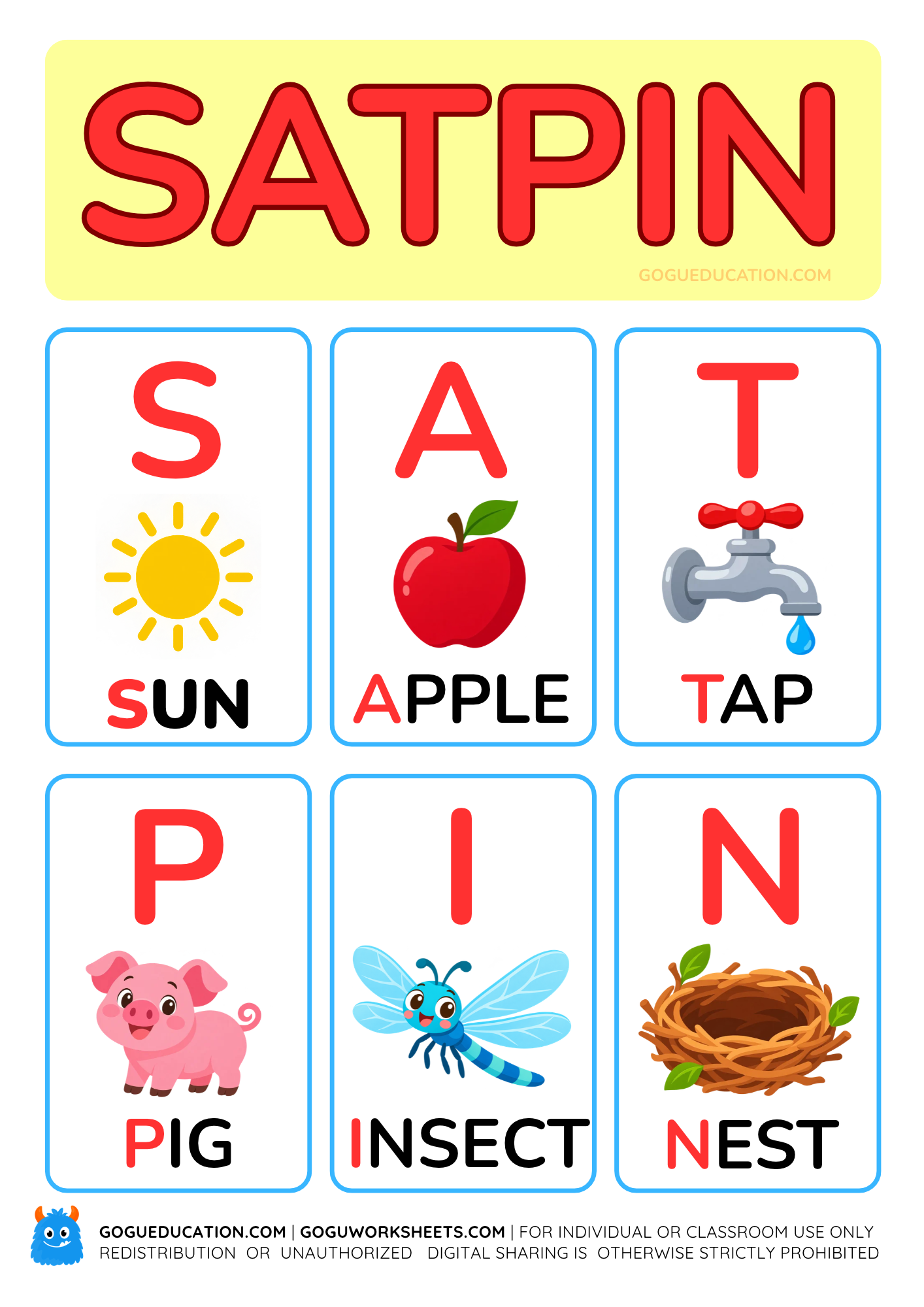
SATPIN Phonics Poster: Free Printable English PDF
Discover the first six phonics letters: s, a, t, p, i, n. This colourful SATPIN poster helps beginning readers recognise letters, connect them with sounds, and take their first steps towards reading simple English words.
What Is SATPIN in English Phonics?
SATPIN is a common starting sequence for teaching phonics. The letters are introduced in the order s, a, t, p, i, n. They are useful because children can combine their sounds to read several simple words early in their learning.
What Words Can Children Read with SATPIN?
Once children recognise these six letter sounds, they can begin blending them together to read simple words. Many of the first words follow a consonant-vowel-consonant (CVC) pattern.
Frequently Asked Questions About SATPIN
What does SATPIN stand for?
SATPIN refers to the six letters s, a, t, p, i, and n. They are commonly introduced first in systematic phonics teaching.
Why are these letters taught first?
These letters can be combined to form many short, decodable words. This allows children to begin practising blending and reading at an early stage.
What age is SATPIN suitable for?
SATPIN is often introduced to children aged approximately 4 to 6, although the appropriate starting point depends on each learner’s readiness and experience.
What is blending in phonics?
Blending means joining individual sounds to make a word. For example, /s/ /a/ /t/ can be blended to read “sat”.
Can I print the SATPIN poster for my classroom?
Yes. The free PDF is intended for individual and classroom use under the licensing conditions displayed above.